



When the PCB launched the Pakistan Cup back in 2016 it had seemed like they were trying to emulate their success in the PSL – the draft system, the limited number of teams, the insistence that all the big players participate; it all seemed designed to capture the new market the PSL had tapped. Sure, it was just a repackaging of the Pentangular Cup, but it was a step in the right direction.
And while that tournament will never be the PSL, it has defined its own niche in the Pakistani domestic calendar. It is the event that bookends the overblown Pakistani domestic season – the finishing touch on top of the plethora of cricket that precedes the previous eight months.
And as always there are lessons to learn from it.
Finally Catching Up
One of the more fascinating things about the domestic scene in recent years has been how the mindsets and targets for what is conceivable in the 50-over game have evolved over the past four years (since the Pentangular was re-launched).
There has been a clear uptick in what is considered an acceptable target to set. From the nadir of 2015 when the whole tournament had no 325+ scores, to this edition where a third of innings breached that benchmark Pakistani batting has come a long way. The fact that those scores are considered chase-able is a by-product of a changing mindset too. Pakistani domestic players, at least in the Pakistan Cup, are playing something close to what the international game demands.
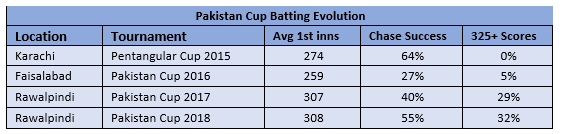
There are obvious reasons behind this: the increase in T20 cricket Pakistani players participate in, the worldwide change in the way 50-over cricket is played and how far behind the times Pakistan have seemed over the course of this decade. But one overlooked factor is the scheduling of the tournament. Coming at the tail-end of the domestic season it takes place in April and May – when the pitches are no longer green minefields, and when the overhead conditions are not advantageous to medium pacers anymore. The contrast with the other 50-over tournaments, which take place in the middle of the winter (and thus do support that type of medium pace bowling) are obvious.
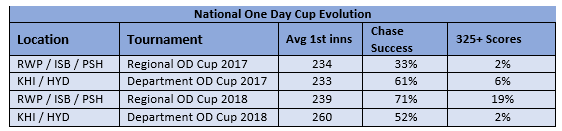
The majority of the Pakistani domestic game – 85% of the List A matches being played in Pakistan – is still set in the months of December and January, working around the PSL and the Quaid-e-Azam Trophy, and pose questions to Pakistani players that they won’t be asked for in ODI cricket (the odd game in New Zealand aside). Consequently, the Pakistan Cup is a lighthouse for the administrators to follow as far as the limited overs tournaments in domestic cricket are concerned.
Every batsman is a king
The problem with having a First Class system that produces mostly guys who bowl around 135kph and rely on the off the pitch movement is that when they are removed from that comfort zone they become toothless. Thus domestic 50-over cricket in Pakistan is dominated by top order players – players that can survive the new ball in the December/January tournaments and thus capitalize, or in the case of the Pakistan Cup, have the ability and desire to bat long. The positive in this is that this allows budding young batsman to actually learn how to build their innings and learn the art of batsmanship – something they don’t really learn in the bowler-friendly First Class tournaments.
The flipside to this equation is that if everyone is exceptional than perhaps no one is. Shan Masood is the current owner of the highest List A average ever. EVER! He’s a shade ahead of Michael Bevan and Virat Kohli who occupy the following spots. Khurram Manzoor, Shan’s opening partner in the Pakistan Cup and the top scorer in the tournament, finds himself in 5th, sandwiched between Cheteshwar Pujara and AB De Villiers. Neither Shan, nor Khurram, seem to be in Pakistan’s ODI plans going forward.
The reason why their numbers don’t jump off the screen is simple: of the 40 highest List-A averages in cricket 11 belong to active Pakistani batsman. When everyone is a king then no one is a king. And if that’s the case numbers no longer speak loudest – whether the audience is the selectors or the fans; then subjectivity rules.
Keep Calm and Carry On
While it may appear that the current state of the domestic 50-over game is a problem, it quite frankly is not. Perhaps the number of matches in the national one-day tournaments (both department and regional) have to be reduced to increase the number of Pakistan Cup matches, but beyond that not much needs to change. The Pakistan Cup exposes Pakistani players to higher quality opposition, and batsman friendly conditions – things that are rare in the domestic game but are the foundations of the international game. These, right now, are birthing pains to a system that has been stagnant for a decade or more. The more cricket on these pitches and in these conditions the batsman play, the closer they will be to the international game. While the rest of the world inducts ready-made batsmen into their national teams, Pakistan – even in 2018 – have to take a punt on, and spend years developing, someone who might not end up being good enough. Pakistan Cup, and tournaments similar to it, minimize those risks.
But these tournaments are equally important for the Pakistani bowling stock – the crown jewel of the domestic season is the Quaid-e-Azam Trophy, after all. That’s the thing department and regions build their teams around. The result is that players who are most suitable for that – medium pacers who hit the top of off, batsman who don’t take risks and know their limitations – then graduate higher up. For the rest of the year they bowl to diluted teams (the Pakistan cup has five teams, the PSL has six, other tournaments are lucky to have as few as sixteen) in easy conditions: thus, they don’t learn their defensive skills. There are only a handful of pace bowlers in Pakistani cricket who bowl around 135kph yet have the skill to be able to defend themselves, and the temperament to bounce back when hit around. The majority are those who have only learnt how to take wickets on greentop, and any time they have extend themselves they buckle. Ask yourself this, when was the last Pakistani fast bowler – particularly someone who had done great wonders in the Trophy – included in the national team and seemed like he was at home on the flat decks that dominate the international circuit?
Tournaments like the Pakistan Cup will thus force them to learn new skills – the ability to bowl a Yorker (wide or at leg stump) or a bouncer (slow or at the head) at will, and the ability to take wickets when the pitch or overhead conditions offer nothing. And as that talent pool increases, the practitioners will push each other to further improvement. So, while it may feel like the Pakistan Cup is the death of fast bowling in Pakistan, it’s the best thing to happen to it this century. Let’s not fix what ain’t broke.
The views expressed in the article are the writer’s own. They do not necessarily represent the views of Islamabad United