


Departments dominate, regions bounce back and the stories that define domestic cricket in Pakistan
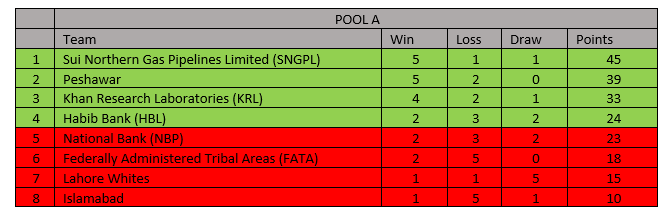
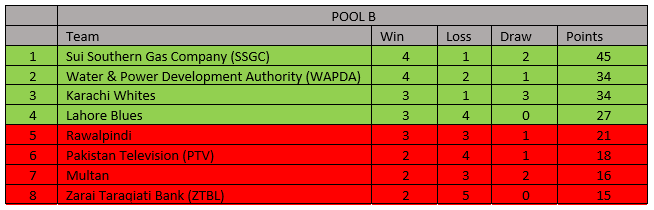
With the first round of the 2018/19 Quaid-e-Azam Trophy now finished, this is how the teams line up.
- Pakistani domestic cricket has an elite
Five departments qualified for the Super Eight stage of the competition this season, and none of them are a surprise. Not only have each of SSGC, SNGPL, HBL, WAPDA and KRL have qualified for the latter stage this season, but each of these five teams also qualified for the Super Eights in the past two seasons. If UBL were still an active team you would have bet on them to qualify for the Super Eights too, as they had done for the last two seasons: in which case six of the eight in the Super Eight stage of the Quaid-e-Azam Trophy would have been the same department teams three years running. While the other 10 teams in the Trophy fluctuate there is a pretty clear elite in the Pakistani domestic game. Sure, it’s been cut from six to five thanks to UBL’s closure, but the rest remain.
The reason for this is the depth that these teams have accrued over the years. Think of SNGPL, for instance – they have won the foremost First Class tournament in the country in five of the last six years. Their middle order in their second match of this season included Mohammad Hafeez, Asad Shafiq, Iftikhar Ahmed and Mohammad Rizwan. By the end of the tournament with each of those players in the UAE with the national or A team (along with the likes of Asif Ali, Hussain Talat, Rahat Ali, Mohammad Abbas, Yasir Shah, Shaheen Afridi and Shadab Khan from their roster) they could still field an XI with five players who have played for Pakistan, including Taufeeq Umar and Misbah-ul-Haq as high quality backups. That’s a level of depth that most Regional teams can only dream of. And that’s why any tournament with both departments and regions will always be lopsided.
2. The Three that failed, including one surprise
Thankfully there were three departments that did fail to reach the Super Eights, just for some variety. Two of those I pretty much predicted in the preview of the tournament but the real surprise was NBP. Neither ZTBL nor PTV had qualified for the Super Eights in the last two seasons too, but NBP not qualifying through, even with the reinforcements from the UBL shutdown ought to be considered a disappointment.
But they have a ready-made reason/excuse for that. Unlike the other major department teams they haven’t been able to hoard up players to form a deep squad. And with many of their players getting surprise call-ups, their XI was often left to their second string. None of Bilal Asif, Mohammad Asghar, Shan Masood and Mir Hamza played more than four of their seven matches. With that core removed NBP did not have anyone else step up in their place: none of their batsmen averaged over 40, none of their bowlers averaged under 25. Of course, they were not helped by the fact that they were in Pool A with SNGPL, KRL and HBL, meaning that if even one regional team over-performed (as Peshawar did), one major department team would have been knocked out. And thus, the lone big team to fail reached its conclusion for this season. But you do wonder if their fate would have been the same if they had been in the relatively weaker Pool B.
So, expect NBP to bolster their squad for next season, probably by raiding regional teams, of course.
3. A Better Showing by the Regions
The typical cycle of the domestic Pakistani player goes like this: he comes through the club or underage system of a region, joins their senior team, excels there for one to two seasons and then is picked up by a department at three to four times the wages he would get at his region. Then he remains with that department team until that team is relegated or he sits on the bench so often that he gets frustrated and returns to his region. Meanwhile, the region tries to unearth a suitable replacement for the departed player, a process that can take years, and when they do he’s gone in a season or two too.
Considering that, these are regional teams that have qualified for the Super Eights over the past three seasons:
2016/17: Karachi Whites
2017/18: Lahore Blues and Lahore Whites
2018/19: Peshawar, Karachi Whites and Lahore Blues
None of them is a surprise. Karachi and Lahore have so much depth thanks to their population and grassroots infrastructure that they can compete no matter what. Consider the Karachi Whites team that has lost only one match this season. Their top run scorer, and the highest run scorer in the Trophy this season overall has been Khurram Manzoor, who spent several years at the now relegated Port Qasim Authority (PQA). Their second highest scorer was Mohammad Hasan, who too is contracted to PQA, but can play for his region thanks to his department not being in the Trophy. The same is true for Mohammad Sami and Anwar Ali (who is with PIA). Add that to Saad Ali, the highest run scorer in the Trophy last season, who decided to return to his region rather than get a new contract at another department once his team (UBL) folded. This means that regions which produce a lot of players can still survive, which is also why Peshawar has been able to compete so well with the rest over the course of this decade. But what about the rest? What about, say, Multan?
In a normal domestic cricket system, Multan would right now have a new ball pair of Rahat Ali and Mohammad Irfan, with Zulfiqar Babar as the lead spinner, under the captaincy of Sohaib Maqsood. But the last time any of those four played for Multan was in February 2013. Since then Multan haven’t really been able to replace any of them.
This is the sort of situation that makes one wonder. Regional cricket associations are often accused of being wholly occupied by nepotism, corruption and an inability to develop players. But where’s the motivation for them? They are competing in the Trophy but none of them are ever likely to even reach the final; their aims are restricted to avoiding relegation to Grade II. Any player that they develop can be picked up by a Department, and unlike European football where at least the second-tier sides have transfer fees in exchange for developing and selling players, these regions end up having nothing to show for their work. So, one wonders, are those complaints of favoritism and corruption in regional cricket associations a by-product of our society as a whole, or a domestic system that does not reward their development of players or any long-term planning? The questions for regional vs department cricket, as is the issue du jour, are far more complex than they may appear.
4. Departments vs Regions
Excluding PTV and ZTBL, the black sheep among departments, this is the record of matches between regional and department teams this season:
Played 24, Department Wins 13, Region Wins 6, Draws 5.
And three of those six regional wins belong to Peshawar, perhaps the only regional team with the structure and the management to be able to compete with departments. Perhaps we need to find a solution to this inequality or hope that all regional teams learn from and are able to emulate what Peshawar have done.
But the fear is that Peshawar’s performance this season will be an anomaly, with their best players being hoovered up by departments next season, and we will be back to where we were last season. The record for departments against regions in 2017/18 was:
Played 36, Department Wins 24, Region Wins 8, Draws 4.
I don’t know much about cricket, but what I do know is that this statline does not suggest a highly competitive tournament.
5. ZTBL and PTV
To finish off, the two department teams go against the grain. Every year one regional team and one department team is relegated to Grade II, and out of First Class cricket. This year, as my preview suggested, this was a straight shootout between two: ZTBL and PTV. How, in a tournament that is so heavily tilted towards departments can two teams struggle so much?
The one common thing across both these teams is their refusal to spend, with the excuse for that being that they are investing in young players. With ZTBL that’s a claim that makes sense, with their average age being under 25, but the average age of the twenty players that played for PTV (27.65) is hardly that different from the average age for SSGC (27.85), the team that ended up topping their Group. The difference, of course is that it’s not just about having young players but investing in the best of them. SSGC this season had the likes of Fawad Alam, Umar Amin, Sami Aslam and Sohail Khan as their core to go with youngsters like the Zia-ul-Haq and the leg spin duo of Mohammad Irfan Jr and Usama Mir. The only international players to play for PTV this season are Raza Hasan and the returning Abdul Razzaq. But being able to spend less than any other department and still save yourself from relegation thanks to a last day win must count as a success for PTV. Plus, their performance in the Quaid-e-Azam Cup (the premiere 50-over tournament) means that this season can be considered a success.
ZTBL, though, don’t even have that to fall back on. They’ve lost five of their six Quaid-e-Azam Cup matches and are now relegated back to Grade II from the Quaid-e-Azam Trophy.
So, I’ll finish off with the story of ZTBL, and how for all that we may curse the state of regions, the state of departments hangs on the whims of a few men too.
At the start of this decade Zaka Ashraf, the president of ZTBL at the time, was appointed the PCB Chairman. As would have been expected ZTBL began to invest more in their cricket team. Just under five years ago they won the National T20 Cup for departments (the only time that tournament took place) with a team that had seven current or future Pakistan internationals. Even outside of these seven they had players like Babar Azam, Hussain Talat, Zafar Gohar and Abdul Razzaq on their books. By that stage, of course, Zaka Ashraf was in a tug-of-war with Najam Sethi for the big seat. With him having lost that war ZTBL began to cut back on their spending, and their main players departed. The last straw was the appointment of Abdul Qadir as the head coach, who brought in the populist belief that far too many fans in the country share: throw out every established player and play only youngsters. ZTBL were relegated and spent some time in Grade II. They returned to the big leagues this year, led by Saad Nasim as their captain and best player. But even before this season started he resigned from ZTBL, including returning a month’s salary to his department, just to get away from his coach. Qadir meanwhile began a campaign to make sure that Saad Nasim couldn’t play for his Lahore team. The situation was resolved with Saad allowed to play for his region. He has played every match for Lahore Blues thus far and has helped them qualify for the Super Eight, meanwhile the team he brought up is now going back to Grade II.
With a lack of robust institutions, the state of so much in this country rests on the whims of a handful of men in charge. In the past six months we have seen how that can go wrong at both UBL and ZTBL. But alas, that’s not a concern that is limited to cricket in this country.