


DOMESTIC CRICKET ROUNDUP SEPTEMBER 2018
- How about them pitches
I start with the pitches, because where else would it start. It’s been an obsession of mine since I was educated on it as one of the reasons behind the failure of Pakistani domestic cricket by Bazid Khan a few years back, and it’s not something new: https://www.dawn.com/news/1198135
So, here’s a summary. At the turn of the century, Pakistan changed its domestic pitches from bone dry to green because the PCB at the time – headed by Ramiz Raja – assumed that having to play on difficult tracks would create batsmen adept at playing in bowler-friendly conditions. Instead what happened was that with wickets now being seamer friendly, pace bowlers no longer had to rely on brute force, pace and swing to succeed and the one thing that Pakistan was best at producing – express fast bowlers – were no longer a necessity in the domestic game. Meanwhile, fifteen years on, Pakistan batsmen are no better than they were when these changes were introduced, instead with no experience of “Asian” pitches they can no longer dominate their continent as they once did too. Furthermore, playing in difficult conditions at home has meant that their ability to bat long has not really developed.
Over the past decade, Pakistani batsmen have scored 22 scores of 150+ in Test cricket. 17 of those 22 belong to three men (Younis with 8, Azhar with 5 and Hafeez with 4). If we take Azhar out there’s only been one score of 150+ by a Pakistani who debuted after 2003 (Fawad Alam vs SL in 2009). A domestic system that minimizes one of your strengths, while not solving any problems may appear ideal for a change-up, but this is Pakistan, so we support the status quo even though we gain nothing from it.
Last year the PCB, in response to articles such as this http://www.espncricinfo.com/story/_/id/21335069/pakistan-domestic-cricket-gotten-better-kind-not-really , informed us that the low batting numbers were due to the newly laid pitches. A year later, it’s time to check back on them.
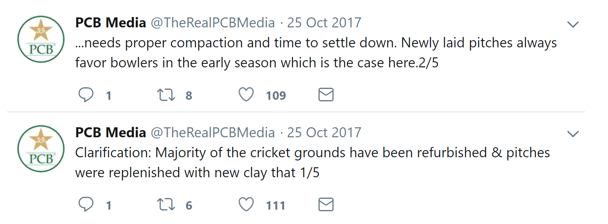
With a month into the new season – a season that started earlier than usual, meaning that the hotter weather ought to produce higher scores – here’s the update:
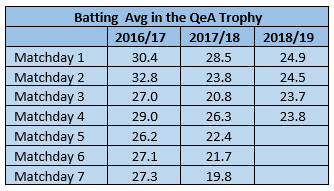
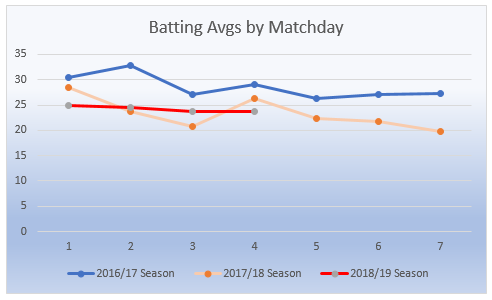
As the numbers indicate, the scores are almost identical to what they were last season, and still have not recovered to the levels of 2016/17 – a season at the end of which the scores were considered so low that reforms (like the introduction of Dukes balls instead of the locally manufactured Grays and the relaying of pitches) were enacted. At what point is the sample size big enough for us to call on further reforms?
- Pitches part 2 – Perhaps we are reading it wrong
Now that we know that the numbers aren’t any better than they were last year, which was supposed to be the nadir, one wonders that perhaps the pitches are better, and the numbers are being brought down by low second innings scores. If only.
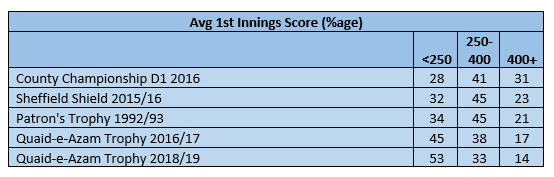
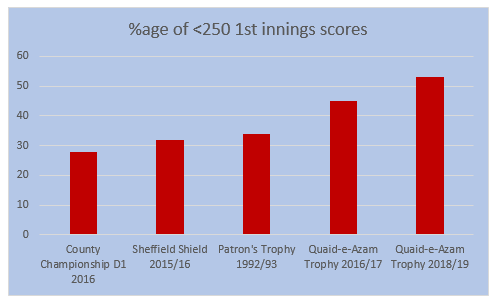
Again, as the numbers bear out, the average first innings scores are even worse than they were two seasons ago. In the best domestic first-class tournaments (County Championship, the Shield or Pakistani domestic cricket in the 90s), around a third of the 1st innings scores finish up under 250. In this season’s Trophy, more than half of the first innings (34 out of 64) have ended up with the team failing to get to 250. Low scores on questionable pitches lead to lower quality cricket, and yet people wonder why players are judged based on the PSL rather than other domestic tournaments.
- Unequal cricket
Last month I wrote an introductory preview to the Trophy https://hostolics.com/islu_b/8-reasons-why-qea-trophy-is-the-one-to-look-out-for/ looking at each of the departments taking part this season. And as expected the four teams expected to challenge for the honors occupy four of the six highest spots in the points table. SNGPL, the powerhouse among powerhouses, are at the top of their group, and on course for another title it seems like.
Of course, departments constitute only half the teams in the competition. There are eight regions in the Trophy and that’s what makes it so unique. Regional players earn about a quarter to a third of what department players earn, have no real financial security and are dependent on the whims of regional bigwigs. So the aim of the best regional players is to perform well (and for themselves rather than the team) and get a contract with a department team so they can be a part of the elite. The result of this usually is an unequal cricket. And it’s something that goes right to the very top.
For instance, consider Usman Salahuddin – he has been under Pakistani consideration for seven years now. He made his ODI debut in 2011, and his Test debut earlier this year in England after Babar Azam broke his wrist. For seven years he has been on the outskirts of the national team, without ever getting a chance because of a historically good Pakistani middle order. He averages almost 47 in First Class cricket and seems to have earned his reward. But here’s a breakdown of his numbers:
Against Regional Teams: 2538 runs at an average of 51.79
Against Department Teams: 2970 runs at an average of 38.57.
So, when Salahuddin ends up performing in Test cricket closer to his numbers against the elite (department) domestic sides instead of his overall numbers it leads to the ex-players (including selectors) ignoring performances in domestic cricket – because if overall numbers don’t lead to quality, and they are too technologically averse to break down those numbers, then they fall back on judging a player purely on the way he plays and their own understanding of cricket.
And that’s how we end up with the owner of the highest First Class average in Pakistani domestic history not playing a Test for nine years. And counting.
- The Backlash
Halfway through the domestic season, the sixteen teams in the competition are reduced to eight as the tournament moves from the first round to the “Super Eight.” It’s usually the time when regional teams are knocked out, and there are mostly departments left to fight it out for the rest of the season in a slightly higher quality stage of the season.
The sixteen teams are divided equally: eight department teams and eight regional teams. In 2016/17 seven of the eight that went through to the Super Eights were department teams. Then last season that number was six. This year, though, it’s a bit different.
With 32 matches completed in the month of September (all of which were department team vs regional team) department teams won only 15 of those. Regional teams have already won 11 matches (as many as they did in the whole of 2016/17) and have done so on the back of two teams.
Karachi Whites which mostly consists of players who are returning to play for the region after their departments were relegated to Grade II. The likes of Khurram Manzoor and Mohammad Hasan play for Karachi as Port Qasim Authority continues to try and get back into the QeA Trophy, and then there’s Saad Ali – last year’s highest scorer whose department (UBL) folded their cricket operations in the offseason. With 3 wins in 4 matches Karachi Whites top Group B.
What’s interesting is what’s happening in Group A though; the team that has increasingly become the third big nursery for Pakistan cricket, Peshawar, has managed to step it up even further than before. They are second in their group in the Trophy and are the only regional team to have won 2 matches in the Quaid-e-Azam Cup (the premiere 50-over tournament). As the center of Pakistani cricket (and increasingly South Asian cricket) moves further to the north and west, it’s a reminder that the strength of a team is overwhelmingly dependent on what goes in the levels below it. There are lessons to be learnt even from our own porch. Peshawar succeeds because their club system is one of the most fruitful in the country. Pakistan doesn’t succeed because the same can’t be said of the domestic first-class game.