


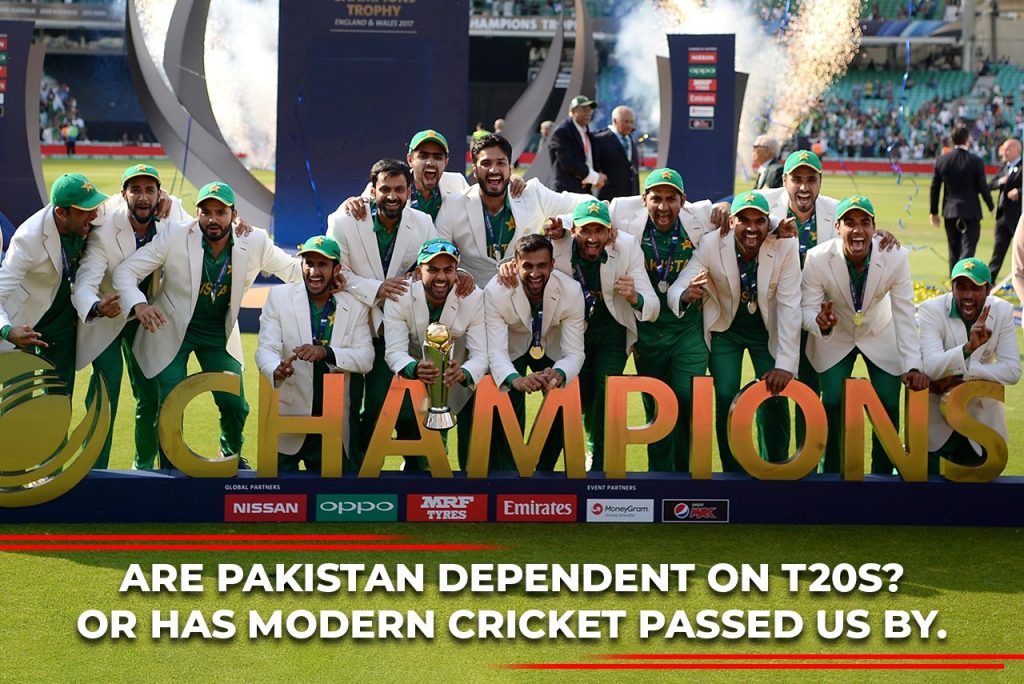
One of the most fascinating things about the narratives in Pakistan cricket is how they go from opinion to fact just by mere regurgitation. As George said to Jerry, “it’s not a lie if you believe it”, and it’s a motto that the Pakistani cricket circles live by. Someone can form an opinion and within a few months that is seen as the objective truth that everyone should believe, even if the facts and the numbers oppose that perspective (see: Alam, Fawad).
The en vogue example in recent years has been how Pakistani players are related to the PSL. Now the reasons for the preference of PSL when it comes to national selection are obvious: instead of a 16 team Quaid e Azam Trophy or 18 team domestic T20 tournaments, there are only six (and until recently five) teams in the tournament. The concentration of talent means that the game is far closer to its international cousin than its First Class version is, so you can gauge someone’s suitability for the highest level better. There are no minnows to feast upon, and with the addition of international players there is no respite either. But alas the narrative makers are those whom modern cricket has passed by, so the general discourse does not consider these things. Now you could argue that the First Class game could emulate that by having a similar concentration of talent, but as the response to PCB’s recent domestic proposals (including the reduction of teams to six) shows the betterment of the game really isn’t a priority for those who talk about domestic cricket in Pakistan.
There’s a pretty simple formula applied to the national team right now: if a player performs well then it’s obviously thanks to his coaches from when he was a toddler till present day (excluding the PSL); but if he fails to perform its obviously because the country is treating a glorified whack-a-thon as an audition for the national team.
For the past couple of years, I have consistently heard the complaints about how Pakistanis don’t play enough First Class cricket, that this generation only plays T20 cricket and is selected based on that format. I’d always suspected that this is a worldwide trend, but those who raise such complaints don’t really follow the international game enough to know that is the case. In bilateral series the teams aren’t usually at full strength so the numbers may be skewed, but with the World Cup upon us I thought it would be a good idea to actually see what the global trend in these matters actually is.
|
Matches Played |
||||
| Team | Avg Age | First Class | T20 | FC-T20 Ratio |
| Sri Lanka | 30.4 | 974 | 1090 | 0.894 |
| England | 29.3 | 1433 | 1708 | 0.839 |
| Pakistan | 27.9 | 796 | 1402 | 0.568 |
| South Africa | 30.4 | 957 | 1729 | 0.553 |
| New Zealand | 29.6 | 771 | 1414 | 0.545 |
| Australia | 30.3 | 739 | 1502 | 0.492 |
| Bangladesh | 27.8 | 613 | 1267 | 0.483 |
| West Indies | 28.5 | 496 | 1324 | 0.375 |
| India | 30.0 | 740 | 2115 | 0.350 |
| Afghanistan | 30.7 | 193 | 613 | 0.315 |
Observations:
- Despite what our media would tell us, the truth is Pakistanis play far more long-format domestic cricket than most other nations. Despite being the second youngest team in the tournament only the members of the South Africa, England and Sri Lanka squads have played more First Class cricket (excluding Tests) than the 15-man Pakistan squad. And in the case of England and Sri Lanka the domestic reformers there have talked about reducing the number of teams to increase quality in domestic cricket too.
- In fact, Sri Lanka are the closest to Pakistan – with the big three, and to an extent South Africa and New Zealand, one could argue that there is enough investment in the domestic system that there is a high level of professionalism, leading to a higher quality of cricket. That is not the case in Pakistan.
- It’s also depressingly hilarious that the Pakistan squad has played more FC matches than the India squad, just six months after we were told (in light of India’s series win in Australia) that we need to follow the Indians when it comes to having players who have years of First Class experience donning the national jersey.
- Considering all our media has told us in recent years it also came as a surprise to me that the five highest ranked teams in ODI cricket (England, India, New Zealand, South Africa and Australia) also have the five squads with the most T20 experience in this tournament. It’s almost as if success and experience in the shortest format, in leagues around the world, leads to success in the ODI game. Add that to Afghanistan and the West Indies whose players haven’t played as many T20s but a far greater portion of their domestic cricket is in the shortest format, and it would appear as if Pakistan, Sri Lanka and Bangladesh are the only three teams left behind by the T20 revolution.
- This isn’t even a skewed Pakistan squad either. If Shan Masood was to replace Imam-ul-Haq and Abid Ali was to replace Asif Ali (both of which were likely scenarios going into the World Cup) the Pakistan squad would have had a FC: T20 ratio of 0.692, far beyond any team but Sri Lanka and England. A three country grouping where the concerns are the same: we need to have quality over quantity in the First Class game.
- Beyond Pakistan there’s a handful of things that jumped out too. Foremost among them is the fact that Afghanistan – even with the likes of Rashid and Mujeeb – are the oldest team in the tournament. For a whole generation this might be the last hurrah, before their T20 generation really takes over.
- The English play more First Class cricket than anyone else, and it sort of explains why they have players retiring from the red-ball game as they do. The players they have right now are cutting down on that format too: Jos Buttler has played six First Class matches since the 2015 World Cup, instead moving on to become the first English born superstar of the T20 circuit. He has played as many First Class matches in England (excluding Tests) as he has played for T20 franchises in the last four years. Meanwhile Imam-ul-Haq has played more domestic First Class matches in the last four years than Buttler, Joe Root and Ben Stokes combined.
In conclusion, despite the fact that Pakistan have not had a single calendar year since 2001 (before the T20 format was even invented) where they ended up winning more matches than they lost against the top-5 (India, Australia, England, South Africa and New Zealand), the reason for Pakistan’s decline is the advent of T20 cricket, aur agar hum First Class cricket ko T20 par tarjeeh dein to hum dobara se best in the world ho jaeinge. After all there is nothing more Pakistani than apne aap ko jhootay dalaasay dena.