


It doesn’t take much to elicit pessimism from a Pakistani crowd. Some of us are in fact old enough to remember when the leading anchors of both the sports channels in the country proclaimed, without any semblance of doubt, that the Masters Champions League in the UAE would out-shine the inaugural edition of the Pakistan Super League. Thus, to expect there to be a realistic breakdown of the re-launch of the Quaid-e-Azam Trophy from the leading talking heads in the country is obviously mistaken. Two rounds of games into this season, though, there are already trends emerging.
Runs Galore
After the first round of matches in the Quaid-e-Azam Trophy the most common complaint, and fear, was that the PCB and their curators had over-corrected their mistakes past. Many commentators on Pakistani domestic cricket had flagged the low scores put up in the Quaid-e-Azam Trophy as the obvious conclusion to everything that was wrong in the domestic circuit. It all came to the fore when the PCB CEO himself talked about those numbers as something that needed to change. Along with the more batsman-friendly Kookaburra ball being used (replacing Duke’s from the past few seasons, which had itself replaced the Grays ball which had been in operation for almost a decade), the pitches have returned to what many would consider quintessentially Pakistani. The results are already obvious.
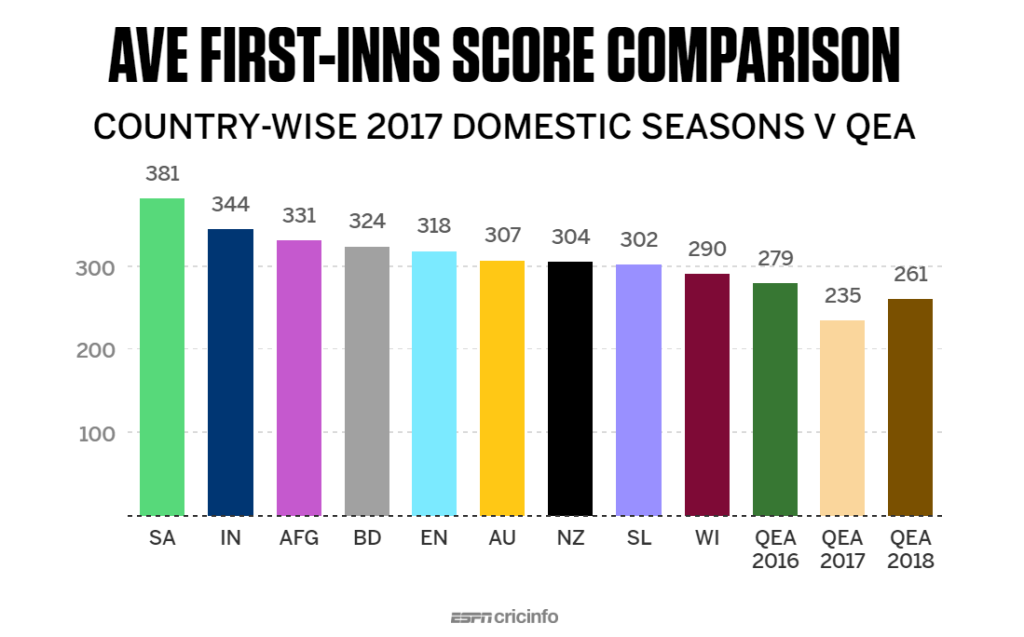
After years of the QeA Trophy being the backbencher among domestic competitions the world over, things have begun to change. The first two rounds of this season have produced an average first innings score of 395 – which, if it were to continue, would take the QeA Trophy from by far the lowest scoring First Class tournament in the world to the highest scoring.
And while that may seem like it is devaluing the runs being scored, this is exactly the sort of thing the national team has needed for years – batsmen who are comfortable and adept at scoring big hundreds. After all, with the exception of Ahmed Shehzad and Fawad Alam, no batsmen who has made his First Class debut in the 21st century has yet to score a 150 for Pakistan in Test cricket. Two rounds of matches (total 6 matches) into the season there have already been eight 150+ individuals scores; for comparison there were 16 such scores in the whole of last season.
Return to Pace and Spin
The greatest number of overs Yasir Shah has ever bowled in a domestic season was when he bowled 431 overs in 2007/08 (at 36 overs per match). In three other seasons he has taken 40+ First Class wickets – his overs bowled per game in those seasons are 33.4 overs per game (in 2009/10), 33.4 (in 2012/13) and 28.1 (in 2013/14).
35 Tests into his career he has bowled 1882.1 overs – which averages out to 53 overs per Test.
Simply put, even the exceptions from the domestic game are not prepared for the challenges they face at the highest level. As Yasir’s efficacy and fitness have come under question over the past couple of seasons those numbers have been fingered as one of the keys to this decline. The recent passing of Abdul Qadir brought this further into focus. By the time Qadir turned 23 he had already had two seasons where he bowled more overs than Yasir has in his entire career. Qadir finished his Test career averaging 42 overs per match, but he could retain his efficacy because of what he had to do in domestic cricket. Excluding Test cricket Qadir bowled over 5,000 overs at 37.3 overs – thus the challenges and fitness he required in the domestic game was far closer than what Yasir has had to face.
Two rounds into this season Yasir Shah is the highest wicket taker in the competition, which is obviously a far cry from just the season before last when there was not a single leg or off spinner in the top 40 wicket takers. https://hostolics.com/islu_b/16-teams-0-off-spinners-0-leg-spinners/ But perhaps more importantly he has done that in over a hundred overs. Shadab Khan meanwhile bowled 44 overs in his first innings of this season, the most he has ever bowled in his career. Similarly, Bilal Asif has already bowled more overs in two matches this season than he did in all of last season (when he played 4 matches). Whatever the drawbacks of the current changes in the domestic game, one thing should be obvious – this format and structure is far better suited to preparing and developing spinners than what it replaced.
And perhaps the same is true for fast bowling. Although that is a judgment which can only be made in a year or two, there is already a consensus building among the captains of the six teams that they will have to rely on extraordinary skill or pace from their pacers to succeed – gone are the days of just hitting a good line and letting the pitch and the ball do the rest. Unlike spinners, for whom this adjustment has been as mental as it is physical, pacers are being asked questions they don’t have answers for. In the long term what it should lead to is that players who perform at the domestic level replicate that at the international stage, but in the short term there will be a lot of pain and a lot of careers put under question. Already we are seeing teams relying on the likes of Musa Khan and Bilawal Bhatti just because they are unlike the majority of their contemporaries, but this is only the first step in Pakistan’s aim to return back to it being one of the foremost nurseries of pace bowling in world cricket.
A Draw Is Good For You
Yet for all that is good that has happened so far the headlines will point to the fact that five of the six games thus far have been drawn. That has its advantages (allowing batsmen to bat long, forcing spinners to bowl long, and be the attacking bowlers on day 4, etc) and has its cons (the value of runs is diluted, the challenge isn’t that great, and with the result out of the question players begin to think of their own numbers rather than the result), but not all draws are created equal. The contrast between the two Northern games and the two Sindh games is perhaps the encapsulation of it.
In their first game Norther needed hundreds on Day 4 from Asif Ali and Mohammad Nawaz to survive to a draw after being followed on – a feat that was matched by Southern Punjab against Balochistan in Round 2. In their second game Northern couldn’t repeat their feat and suffered the only loss of the tournament thus far. In both those matches (and the Balochistan-Southern Punjab game) the result was only made possible by the fact that the team batting first scored their runs at over 3.8 an over.
Contrast that with the two Sindh games: in their first game of the season Sindh scored 473 runs at 2.79 an over, which meant that their bowlers never had the time to get any pressure built. In their second game Sindh scored 476 at 3.2 an over – with a whole session devoted to Mir Hamza surviving at one end while Fawad Alam got to an improbable century. The result was the same as the first game – Sindh, playing in Karachi, were unable to get even ten wickets.
As the season goes on teams will have to learn from what teams against Northern did, and what Sindh failed to do. Simply put, to be successful teams will have to play proactive cricket. And that too, for all its issues, is something that can only serve Pakistan cricket well.